
It’s tough to review a mystery. How do you say what makes the show work without giving the game away? Fortunately, Gannon University’s production of We Are the Tigers, by Preston Max Allen, offers us plenty to talk about. This show sails on the strength of its rollicking score, heartfelt storylines, and killer cast.
In this 2019 musical, The Tigers cheerleading team, of Giles Corey High- bonus points if you get that reference- are entering a new school year after a humiliating mishap went viral online. New captain Riley, determined to improve the squad, hosts a sleepover that’s less “fun hangout” and more “mandatory planning intensive”- or at least, it was supposed to be. Plans change abruptly when two Tigers meet a sudden and bloody end.
Allen’s script sets the Tigers up with enough drama to sustain a full show even if the murders never happened. We’ve got ex-Olympic hopeful Chess (Ava Stripp) about to leave for college, to the despair of her best friend Kate (Emma Chiarelli). We’ve got good Christian girl Annleigh (Chloe Kassalen), forced to take responsibility for her alcoholic stepsister Farrah (Bella Fried). Riley’s best friend Cairo (Anna Skinner) feels perpetually taken for granted. Then we have Mattie (Alex Afton), the sincere but overwhelmed freshman, and Reese (Moriah Bartlett), the mascot, who longs to overcome years of bullying and finally get on the team. It’s easy to buy into these characters’ lives and struggles before a drop of blood has fallen. Allen sweetens the deal with a winning, ebullient score with a mixture of driving beats and moving ballads.
We Are the Tigers requires strong musical actors across the board, and the Gannon cast rises to the challenge. Konkle’s Riley is the ultimate cheer enthusiast, part perky tour guide and part personal trainer from the Jillian Michaels school of merciless expectation. Konkle sparkles in act one, but in act two, as Riley pilots her team through the aftermath, she becomes a live wire. Skinner gifts the dissatisfied Cairo with her signature powerhouse vocals and plenty of attitude. It’s a thrill to hear her and Konkle go toe to toe in their duet-slash-argument, “Wallflower”.
Kassalen gives vivid life and heart to the perpetually conflicted Annleigh. Annleigh’s zealotry is occasionally played for laughs, but it also genuinely drives her and complicates her responses to the play’s events. Fried slowly dismantles the comic alcoholic trope in a sneakily wrenching performance, throwing body and soul into Farrah’s slow motion breakdown. Meanwhile, Giovanni Natalie charms as Clark, Annleigh’s upbeat boyfriend. He’s a bit overeager, perhaps- but no more so than Annleigh herself.
Bartlett gives us an endearingly dorky Reese. Afton’s Mattie is earnest and adorable, simply a kid trying to stay bright as life crumbles around her. Stripp portrays Chess with a cool, knowing maturity, outwardly friendly and ‘chill’ as she withholds her frustration with herself. Chiarelli is a subtle standout as the forthright, pessimistic Kate, anticipating loss before she knows what kind of loss she’s headed for. Who knew a number about missed video calls could break your heart?
Finally, Peyton Duffey lights up the house as Eva, a top-ranking cheerleader from a nearby public school. Eva struggles not to let her face, or her words, betray her thoughts around “the murder squad”, and Duffey displays formidable comic chops with her barely-restrained responses to their chaos. She’s an utter delight to watch.
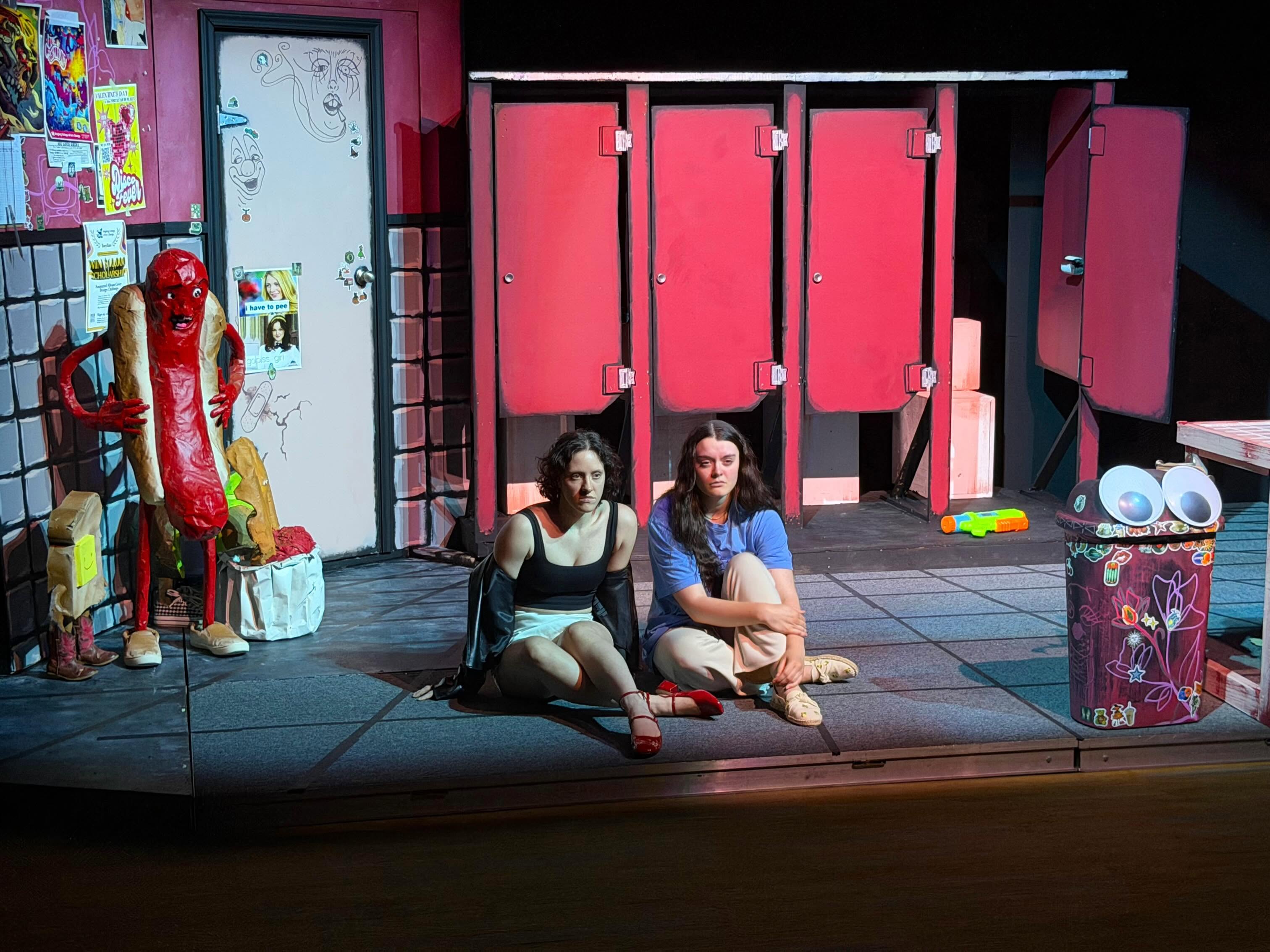
Angela Howell has designed a fantastic multilevel set, in which director Jordan Wolfe has put every location and element to good use. Howell’s costume scheme is simple but effective, featuring casual wear in the Giles Corey High colors of white, black, and a shade you might just call blood orange. Lighting and sound maven Molly Cooke indulges in some pop-concert lighting for the show’s high-energy numbers, but keeps the more reflective moments cool and clear. The show’s small and mighty band, led by Kate Thiem, is situated to the right-hand side of the audience, meaning that the vocal-instrumental balance is (perhaps inevitably) a little bit better towards the left, but I tried both and thoroughly enjoyed both experiences.
There are moments in the show where the writing falters. Cairo doesn’t get quite as much interiority as her teammates. There is a preponderance of slant rhymes, or vowel-only rhymes, and I personally left thinking that the killer’s identity could have been more meaningfully foreshadowed. Even so, I happily went back for round two, and soon after that I was cueing up the off-Broadway cast album in my car.
We Are the Tigers is typically billed as a black comedy or a horror comedy, and this is reasonably accurate. There are some riotously funny lines and some unabashedly zany episodes. Some of the show’s strongest moments, however, show characters dealing with grief- grief over lost opportunities, over a lost sense of self, and inevitably, over lost people. I often say that the sharpest comedy knows when to stop being one. We are the Tigers is screwy fun, but it takes its young characters seriously. Their intensity of feeling isn’t a fault, and their struggles aren’t shallow. They’re human. The show shines when it lets these characters respond to the madness around them, illuminating the social pressures that torment young people and the way that loss changes lives. Pretty cool for a high school murder musical. Go see it.

Leave a Reply