
Everyone knows what happens in 1776.
That is to say, most Americans, and doubtless millions of other people, are aware that in the year 1776, influential white landowners from 13 British colonies in North America voted to turn those colonies into an independent nation, and they drew up an official paper about it. Few of those coming to see 1776 at the Erie Playhouse aren’t going to know how it ends. Luckily, the point of Peter Stone and Sherman Edwards’ 1969 Best Musical winner isn’t the question of, ‘will the Continental Congress approve the Declaration of Independence?’ The point is what it took to get there.
Our protagonist is John Adams of Massachusetts, whose public image threatens to sink his dreams of American independence before they even leave Boston Harbor. His relentless, abrasive speechifying on the matter has made him perhaps the least-liked man in the Second Continental Congress. Despite the merits of his cause, he seems unlikely to win enough support to pass a resolution of independence through a vote. Adams’ ally Ben Franklin recruits Richard Henry Lee of Virginia to proffer the resolution himself, at which point their odds look brighter- until Pennsylvania delegate John Dickinson puts forth that the decision must be approved by every colony. To substantiate their cause and buy some time before the vote, Adams and Franklin commission Thomas Jefferson, a Virginian of a quieter nature, to draft the prospective nation’s Declaration of Independence.
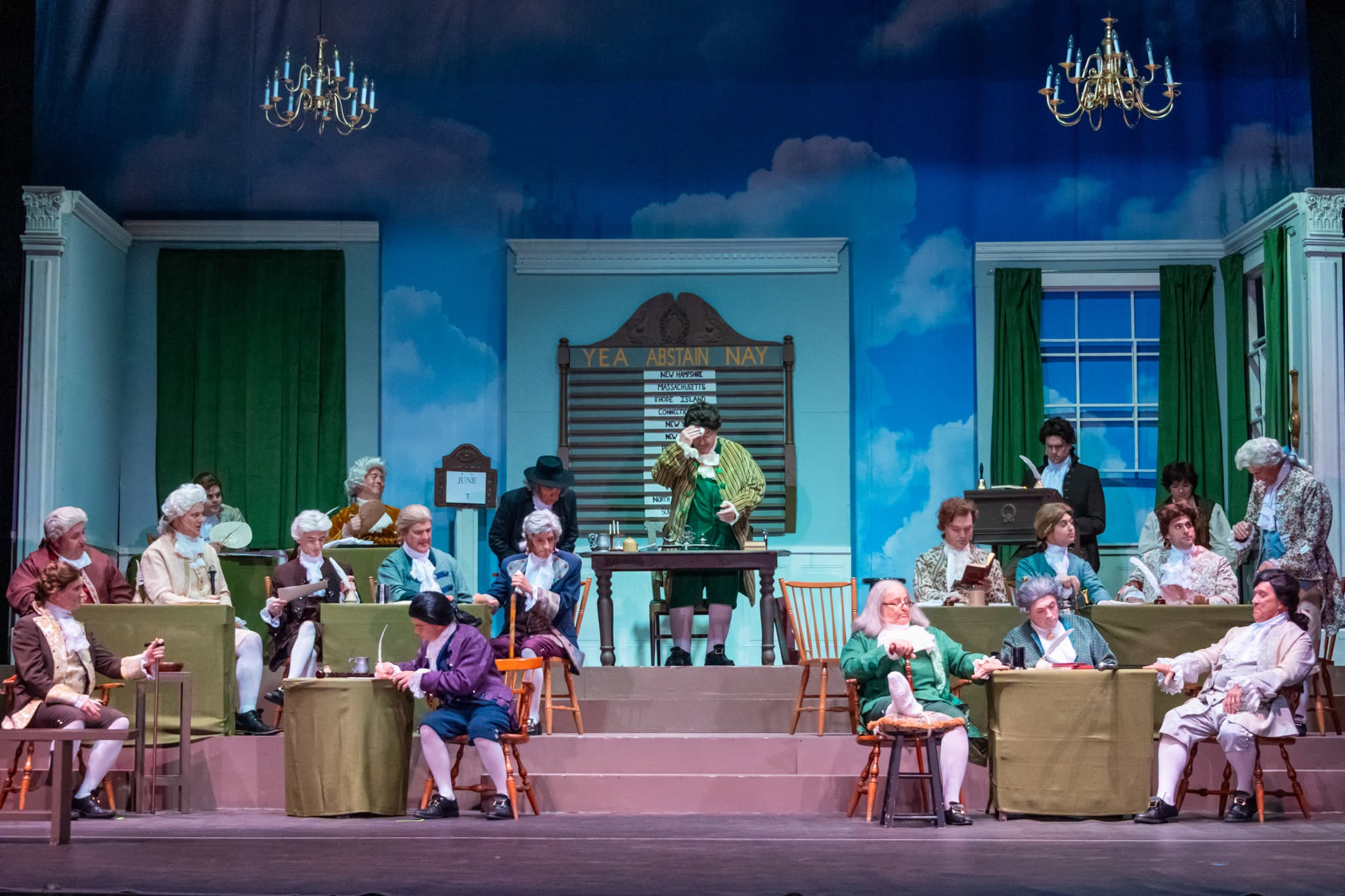
Brandon Vogt makes great use of his cultured voice to suit the musical style of the show and depict Adams’ forthright yet honorable persona. He provides us with a confident and sympathetic anchor as the show moves from instance to instance. Mike Nasca’s Franklin started out sedate but grew more animated as the tensions rise. Arthur Martone’s Lee is an immediate standout, lighting up the stage with an affable vigor. Séamus Clerkin presents us with a Jefferson who is unassuming, yet resolute. Some of his strongest moments are entirely wordless.
1776 is a fun show to watch in Pennsylvania, as while the Pennsylvanian Franklin is Adams’ greatest ally, his fellow delegates- the chaos-averse conservative John Dickinson and the obsequious James Wilson- pose a critical obstacle. Dickinson prizes his English heritage and doubts, not unreasonably, that a colonial rebellion could ever succeed. Bill Hunter portrays Dickinson with dignity and poise, if not a lot of force, at least when set against Vogt’s indefatigable Adams. As Wilson, Michael Graham entertains in what is, for him, an unusually mousy role.
There are too many more individual delegates on that stage to spotlight all of them, but I would like to note a few. Ron Herrera shines in the brief but crucial role of Caesar Rodney, Delaware’s dying firebrand. Herrera shows us a man whose spirit and conviction persist even as his body slowly fails him. Roger Wolbert gives “simple cobbler” Roger Sherman a delightful flair, and Bruce Rockwell presents us with a dignified Dr. Lyman Hall. Patrick McGuire assumes the thankless but essential role of Charles Thomson, congressional secretary. Though he spends much of his time reporting the words of other people, the production would be worse off without his steady declamation and wonderfully subtle shifts in tone that hint at Thomson’s actual feelings about the proceedings.
The show’s 26-part cast features only two women. Alexis Afton offers us a moment of cheer as the youthful, charming Martha Jefferson. Sallie Richards brings a bit more experience to Abigail Adams, John’s intelligent and steadfast wife. Though physically still in Braintree, she appears over and over in John’s mind as the two exchange letters, requests, and words of affection. To reinforce their geographic separation, Vogt and Richards never touch, and often as not they are both placed to sing out towards the audience rather than to each other. Nonetheless, from their spirited quarrels and mutual teasing to their tender and wistful duets, they convince us that the Adamses are a perfect match.
In the era of Hamilton, and several years after the last Broadway revival of 1776 featured a cast with no white cisgender men at all, it’s hard not to notice that this production returns to the old default practice of casting all the historically white figures with white actors. Nearly the entire cast is white, but with one the single exception that made the overall scheme feel purposeful: Colden Lamb as General Washington’s courier. The courier, nameless, in uniform, is the show’s representative of all the ordinary men who served in the struggling Continental Army- thousands of whom were Black. Of all the people on that stage, the Courier alone lives in the dirty and bloody dimensions of the fight for liberty. It is he who closes the first act, with a lamentation for two dear friends he saw slaughtered in the field. Lamb plays this lamentation like a breakdown, all sharp breaths and trembling limbs. It’s jarring enough to see a weary, bedraggled soldier bringing letters of struggle to the finely dressed delegates. It is a harsher thing entirely to see this young Black man serving and suffering as the white men given decisive power argue whether the nation will treat millions of Black people as citizens or as property.
Indeed, much of the second act turns on a debate over an anti-slavery paragraph that Thomas Jefferson, himself a slaveholder, really did include in a first draft of the Declaration of Independence. Adams believes that striking the paragraph would be a moral outrage and a regret of future generations. South Carolina delegate Edward Rutledge makes it clear that if the passage remains, the resolution for independence will be permanently sunk. Slavery, after all, is a pillar of the economy- not just for the Southerners who buy and own slaves, but for the Northerners who transport them and profit from their sale and labor. It takes an unflinching actor with a powerful sound to handle Rutledge. Conrad-Medvis, who strolls through his earlier scenes with the lightest of Southern drawls, commands the stage in the unsettling “Molasses to Rum”, a song that implicates both North and South in the ongoing slave trade. This is where the play forces us to confront the indefensible.
Director Richard Davis has staged the show simply and effectively, with the help of Nico Lombardo’s eminently sensible set. Lombardo has provided a fine tiered platform set with the requisite desks and chairs for the Independence Hall scenes as well as two blank white building corner facades on either end of the proscenium. The blank facades allow for projected patterns that turn the suggested buildings into whatever is needed, be that the interior of the Hall, a Philadelphia boarding house, or Abigail and John’s farmhouse in Braintree. The projection designs are artful and appealing. The costuming is an embarrassment of riches. A well-crafted period costume is a deeply satisfying thing, and my heart leapt at the fine variety presented on the Playhouse stage, arranged by Davis and Ryan Ingram The chamber is a cavalcade of rich colors, shimmering brocades, trimmed tailcoats, and all the marks of 18th-century elegance. Paula Latislaw’s neatly styled wigs perfectly complete this picture.
There were some issues with microphone connections and musical synchronicity on the night I saw the show. Nonetheless, I was able to understand everyone at all times, and the in-person orchestra gave the show additional liveliness and sonic depth. I have to praise veteran drummer Jim Griffey, who stoked my excitement with a sharp and upbeat pattern at the very start of the show.
As I said, the point of 1776 isn’t the suspense over what happens at the end. We know what happens, more than the figures portrayed ever would. The point is to see how we got there. To do that, we have to take a long, hard look at the figures themselves- the people who set us on the path to the nation we know today. What we see, through Edwards’ and Stone’s lens, is that the campaign for independence was never a matter of spotless heroes pursuing a necessary good, but of people whose ideals had to battle with the more profane concerns of public image, security, and property. None of their successes- or failures- were guaranteed any more than ours are. That’s exactly why, nearly sixty years on, 1776 still deserves our attention.
– Kara Headley (Spotlight 814)

Leave a Reply