

Disney’s The Lion King bills itself as “The world’s #1 musical”. Since its premiere in 1997, this adaptation of the 1994 animated hit has toured the globe and become Broadway’s third longest-running musical as well as the highest-grossing stage musical in history. I probably don’t need to explain the plot. A lion prince’s resentful uncle kills his father and drives him off, making the prince believe it’s his own fault. The prince must come to terms with his past and drive out the usurper to rescue his people. The story, with its echoes of Hamlet and classic coming-of-age tales, is ingrained in the American cultural consciousness. Even the innovation and artistry put into transferring the story to the stage is old news- but it is still talked about. So, upon finally seeing the show myself this past Thursday (July 9th, 2026), I was asking myself: Does The Lion King onstage live up to the hype? Is it still worth seeing, almost thirty years on?
When it comes to the current North American tour, the answer is: absolutely.
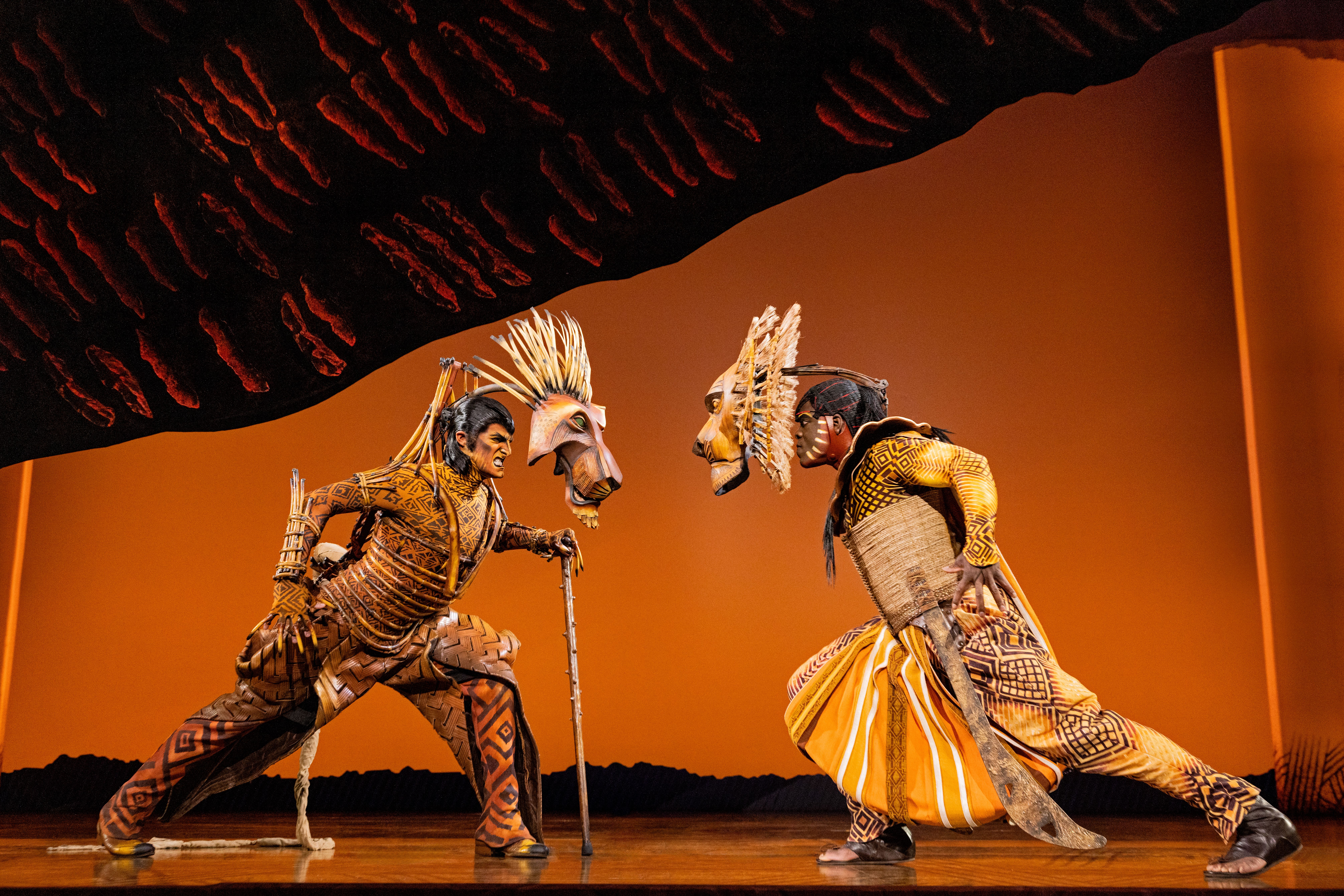
This incarnation of the show has done as its predecessors have: It has gathered an ensemble of dynamite performers and set them up with striking sets, beautifully crafted costumes, and an ingenious array of puppets. The puppetry alone is worth the price of admission. Some are shadow puppets, or sculpted figures on sticks, some integrate the performer’s body with the animal’s, and still another takes four people operating one leg apiece. (Without spoiling the surprise, I will say that sitting in the orchestra section for this show is more than worth it.) The animals aren’t meant to be realistic- they’re meant to be lively. They are captivating functional sculptures that let us see both the image of the animal and the performers at work. The non-puppet costume pieces are just as inventive and diverse. Many characters’ faces, chests, and/or shoulders are painted in bold patterns that function as part of their costume. Puppet, costume, and makeup work seamlessly together to represent each denizen of the Pride Lands.
Of course, all these luminous designs deserve equally luminous performers. The skill and the energy gathered on the KeyBank State Theatre stage could light the block of marquees just outside. First, there is a megawatt ensemble of dancers, giving us balletic leaps and fluid turns, demonstrating extraordinary physical versatility and admirable stamina as they switched from animal to plant to human and back again. In the hands (and feet, and core) of these clearly seasoned dancers, scenes like the lionesses’ wordless hunt are riveting, as spectacular as any effect the show has to offer. The show’s singing ensemble, seen and unseen, brings dimension and sparkle to each number they feature in. All the while, the pitch-perfect orchestra, conducted by Karl Shymanovitz, supports the players like a strong, steady heartbeat.
In the show’s first moments, Zama Magudulela rouses us and welcomes us into the story with her eccentric, exuberant Rafiki. Magudulela has played Rafiki all over the world, and it shows in how frank and comfortable she is in the role. She walks onstage to speak to us like she’s walking into her own living room.
I had the fine fortune of seeing Cedrick Ekra in his understudy track as adult Simba. (The role is usually played by Gilbert Domally.) Ekra slips effortlessly into the role. Charming and expressive, he seems built for the role of an earnest yet troubled young hero. He moves with a fluid and confident grace, and his voice fills the theatre without a hint of strain.
As adult Nala, Thembelihle Cele is graceful and expressive, but lacks the purposeful presence of Ekra’s Simba. Her voice bears an airy aspect, with flashing moments of power.
David D’Lancy Wilson gives us a regal, yet vulnerable Mufasa. Since much of the show’s audience will know Mufasa’s fate coming in, it becomes the actor’s task to make sure we can’t help but love him while he’s here. Wilson aces this mission. His Mufasa is imposing yet kind, affable yet preoccupied by the need to set the best example for his pride and for his son. His moments with young Simba are among the most touching and truthful of the entire show. It’s simply icing on the cake that their heart-to-heart lets Wilson reveal one of the smoothest, fullest singing voices you’ve ever heard.
As Scar, Mufasa’s brother and opposite, Peter Hargrave struts and preens with sinister aplomb. His character voice is rich, from angry barks to languid drawls, and he pours his entire body into Scar’s attitudes and affectations. An early scene of argument between Scar and Mufasa let both Hargrave and Wilson show off striking and suitably catlike physical finesse. In Scar’s iconic villain song, Hargrave demonstrates a strong lower range, but elects to frequently shift between octaves and from singing to speaking, perhaps to stand out more distinctly over the background vocals.
Scar’s buffoonish but vicious hyena lackeys, Shenzi (Martina Sykes), Banzai (Forest VanDyke), and Ed (Robb Sapp), are outstanding in performance and in construction. The puppets are both flexible and genuinely fearsome- though Ed looks rather like an unsettling hybrid of his sharp-faced kin and Goofy. All three were boundlessly energetic, in voice and in body. Sykes shines in the brash and cocky inflections of her character voice, and VanDyke’s lush vocals in “Chow Down” had me hungry for more. Sapp makes the most of a character who speaks only in movement and noises. I enjoyed every minute of this triple threat trio.
Another standout is Nick LaMedica as the formal, fretful hornbill advisor, Zazu. Unlike the other animals, Zazu is occasionally aware of his format. There is the costumed Zazu actor and there is the lifelike Zazu puppet, and at select times, one of them will appear without the other. LaMedica is more than up to this double assignment, as capable in slapstick and silent-film style antics as in puppetry and voice acting. When necessary, he creates the impression of separation between himself and the puppet, and then he goes right back to making the puppet our singular focus. Vocally, LaMedica gifts Zazu with a proper pomposity and deliciously dry wit.
Nick Cordileone and Danny Grumich delight and entertain as Timon and Pumbaa, Simba’s comical companions- slash- guardians. I will admit: the rigs took some getting used to. Pumbaa has a puppet rig where the actor’s legs are his forelegs and their arms control his large mouth and tongue, while the actor’s real face is painted bold black and white. This allowed Grumich to use facial expression in his performance. The rig for Timon looks like a puppet stuck to the front of an actor who is clothed and painted like a human greenscreen, so that we pay minimal attention to his human face. It took me a moment to stop noticing the arrangement, but by the top of the second act I had fully bought in. It was only after the fact that I contemplated how difficult it must be to act without arm or hand gestures, like Grumich, or to have to translate my movements into a smaller body like Cordileone. They made it look natural.
I have to note, with great approval, that Cordileone has a unique voice for his Timon, rather than mimicking film actor Nathan Lane. Comparison is inevitable with such a predecessor, but this was Cordileone’s Timon, and he owned the role. Grumich’s gregarious Pumbaa spoke with a hearty gravel much like film actor Ernie Sabella’s, which seems to be accepted precedent for the character. In both cases, the similarities felt like homage, not imitation.
The Lion King features alternating sets of child actors in the sizeable roles of Young Simba and Young Nala. On Thursday, Aaron Chao played the young prince, with Journey Compas as his partner in mischief. Chao brings the playful, bounding, yet slightly gawky energy of a child who is racing to be a grown-up without really knowing what that means. Compas is on another level. She brought Nala to life with stunning vocals and a poise and confidence almost beyond her years. Should she choose to stay in the business, I am certain this is not the last we’ll hear from her.
The quarrels I have with this adaptation are the same ones I recall having with the movie. Firstly, the women get short shrift. Despite some new material, our leading lady Nala remains underwritten. It’s not clear what distinguishes her adult self from her fierce fellow lionesses, save that we know her. She is not the figure who ultimately propels Simba back home, so their hurried romance feels more decorative than essential. A plotline where Scar attempts to seduce her pops up for maybe three skin-crawling minutes before vanishing completely. But if Nala is sparsely sculpted, Sarabi, Queen of Pride Rock, is a fragment. She exchanges only a scant few lines with her only child, Simba, and none with her husband Mufasa. Her son never thinks of her as a reason to come home. Only one brief scene seems to actually be about her. Given the crucial place she presumably occupies in Simba’s and Mufasa’s lives, it seems negligent for the writers to have given her so little attention.
My second quarrel is that the plot meanders in the second half. Scar’s machinations and Simba’s youthful missteps drive the first half, but once Simba leaves home, it’s practically all coincidence that gets him to come back. Even meeting Nala again isn’t enough. He needs to encounter Rafiki, who he hasn’t said a word to before, and whose exact role in the society of the savannah is unclear. (Is she some kind of shaman? Does she work for the king?) There is little sense that Simba’s return is inevitable by any rule but narrative convenience. When he does return, the events fall one atop the other, with little time for the emotional shifts to land.
All of that said: There is much in the second half worth staying for. The meeting between Simba and Rafiki is a sublime moment of theatre, with Zama Magudulela’s deft and sweeping vocals leading us into another breathtaking moment where gorgeous musicality meets technical excellence. As for the rest: The performances are strong, the music stirring, the scenery eye-catching. The climactic battle features bold stunts and even more thrilling dances. Act II of The Lion King may not be as tightly plotted as Act I, but it’s still a fantastic time.
My first-timer’s verdict is this: Disney’s stage version of The Lion King deserves its artistic acclaim. Original director-designer Julie Taymor and her team did inspired work bringing together a multitude of art forms to translate the animated film into a live production that revels in its craft. Choreographer Garth Fagan created scenes to captivate audiences at all levels of dance literacy. Associate director Anthony Lyn has done a great job maintaining the production’s vitality through its many restagings. And then there are the craftspeople, the builders, the stitchers, the painters, who make the vision real and make it shine. The story has its weak spots, but 30 years on, The Lion King onstage is still a tremendous achievement that is more than worth the visit, particularly with this strong a cast.
And did I mention the puppets?



Leave a Reply